The teachings of the Angel
Occam's razor: inference 3
Black holes reviewed by quantum mechanics
Arguments:
This is a topic that sparks debate: the gravitational singularity versus the Pauli exclusion principle! Normally, black holes can overcome the degeneracy pressure of matter but cannot create impossible realities. Therefore, the Pauli exclusion principle prevents the creation of a mathematically impossible reality (fermions possessing the same attributes in the same spacetime). To force matter to occupy a minimal space, it is necessary to distribute matter across various energy levels to have different attributes, which requires energy. But when all the levels are filled, this must inevitably lead to a bottleneck (Pauli exclusion)... in a spacetime that no longer exists and where everything is lost (singularity). In short, the principle of the gravitational singularity is dubious, and I am not alone in thinking so: "it is a purely mathematical construct that has no physical reality." Therefore, this article is based on a postulate:
"The Pauli exclusion principle cannot be circumvented by an infinite number of different attributes (phases)." However, although confirmed, the Pauli exclusion principle seems to have its flaws (phases), so it is very difficult to draw definitive conclusions. To truly know, we would need to reach an energy level from the beginning of the universe in our particle accelerators, which is beyond our reach.
Abstract :
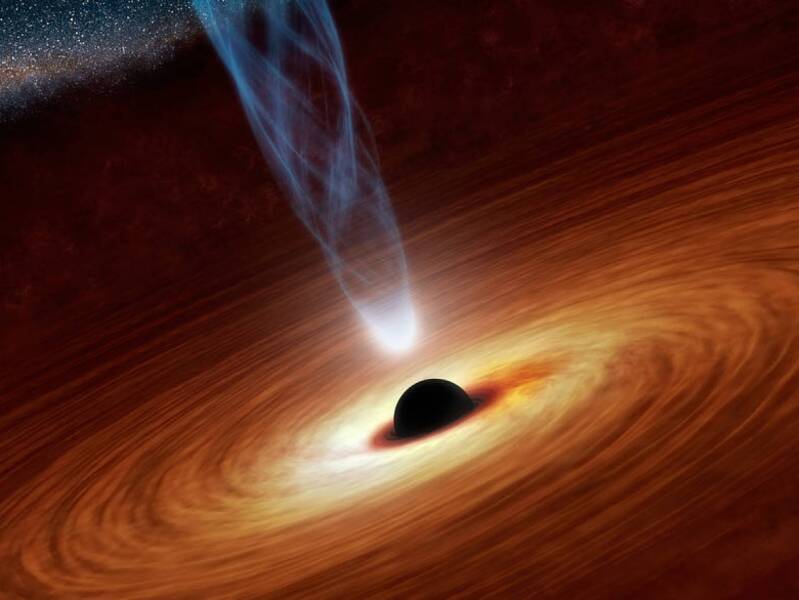
To understand the internal structure of a black hole, one must grasp the concept of "compactness," that is, a very high level of mass/energy potential in space (GeV/cm²). This level is found in black holes and at the beginning of the universe (the Big Bang). In the first case, it involves a collapse of matter due to gravitational fields, and in the second, an expansion of space due to repulsive fields. Thus, even though a state of compactness is reached in both cases, the circumstances are not the same, nor are the related phenomena, since one involves a gravitational center and the other a homogeneous and isotropic universe... which is not the case for a black hole, as it is oriented toward a gravitational center. However, this state of compactness establishes itself as soon as there is an extreme collapse of matter. The quest, therefore, is to understand it in order to visualize it and perhaps even calculate it. In short, what is the most compact state of matter?
Literature Review :
The compact state appears as soon as the Schwarzschild radius is reached. It is a state of extreme compression of matter. However, the viewpoints of general relativity and quantum mechanics are opposed because one considers a space that can be molded at will, while the other focuses on a minimum space necessary for matter. One speaks of certain effects with a precise spacetime and a predictable reality (realism), while the other speaks of probabilistic effects with an evolving spacetime dependent on an entanglement of superimposed realities (surrealism). Since the systems are fundamentally different in nature, it becomes difficult to associate them with mathematics. Consequently, nothing seems able to reconcile the infinitely large with the infinitely small.
However, we can already eliminate what is improbable and illogical… such as matter existing without spacetime (impossible) since matter needs space to exist and express itself (cosmic inflation). Indeed, according to quantum mechanics, matter and energy are probabilistic perturbations due to quanta moving within different quantum fields that interact with each other. No space = no quantum fields, therefore no perturbations. Which is equivalent to saying, no matter or energy either. A minimum space is necessary for these quanta to exist, which is not permitted by the gravitational singularity of general relativity, which speaks of a spacetime collapsing endlessly towards a point/ring… without space or time! A phenomenon that remains incomprehensible.
Introduction :
As previously mentioned in another article (The Big Bang Revisited by Quantum Field Theory), it is necessary to distinguish between gravitational phenomena and the laws of physics that govern them. Gravity modifies spacetime. But this spacetime must nevertheless meet certain conditions. First, the Planck limit imposes a minimum space (10⁻³³ m). Then, the Pauli exclusion principle sets a limit to the collapse of matter. At a certain level, it becomes incompressible. Similarly, Heisenberg's uncertainty principle must also come into play at the heart of a black hole. But how does all this fit together?
Discussion :
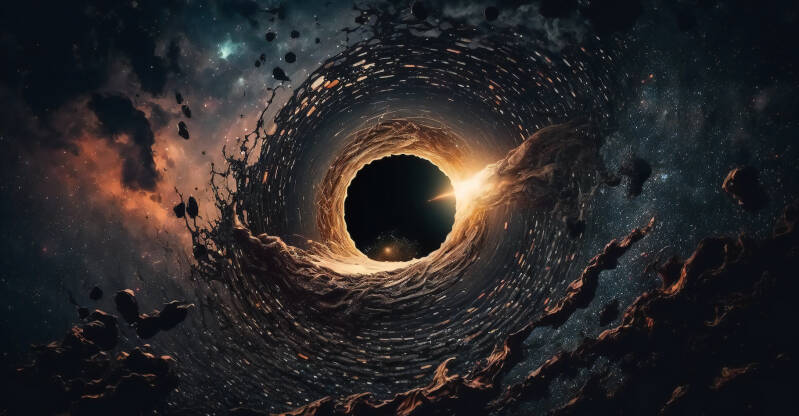
Usually, matter arranges itself into geometric shapes (molecules) made up mostly of quantum voids (more than 99%). Electromagnetic pressure, which is due to the Pauli exclusion principle, prevents molecules from passing through each other, allowing matter to resist the gravity of a planet. In a white dwarf, the molecules no longer hold together. It is the degeneracy pressure (of electromagnetism) that takes over and opposes collapse thanks to this same exclusion principle. In a neutron star, electromagnetism no longer prevails, but the Pauli exclusion principle does. Through the degeneracy pressure of the strong force, it still resists gravity. However, the gravity of a black hole overcomes the strong force, which is an energetic phenomenon that confines quarks together as soon as space allows. Thus, degeneracy pressure is merely a phenomenon (consequence) arising from the Pauli exclusion principle (cause), but it is governed by different forces, resulting in varying intensities for the same cause. Nevertheless, gravity cannot overcome the Pauli exclusion principle, since the latter is one of the fundamental laws of physics. Gravity can prevent phenomena from manifesting, but it doesn't perform magic. Thus, it cannot change the laws of physics by creating a reality that mathematically cannot exist! Therefore, it cannot prevent the Pauli exclusion principle from manifesting. Thus, this scenario doesn't allow for a total collapse of matter with the same attributes, since such a reality cannot exist. Reality is... an infernal mass heading towards a single center. It must stack itself into different phase/energy levels for each particle! In short, at some point, given the number of particles to be squeezed into a minimal space, the phase cup must be full. And that's where things go wrong.
Findings :
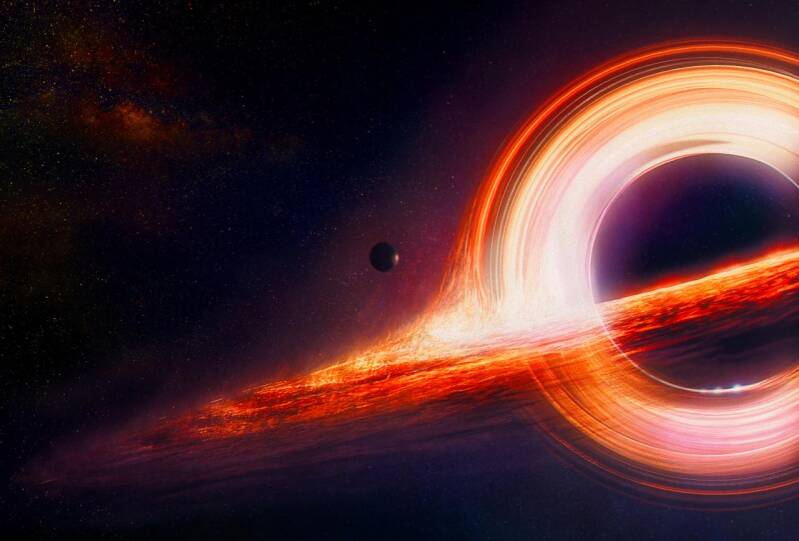
Inside a black hole, the strong force should be overcome as well as the weak or electromagnetic force. This means that particles can no longer organize themselves into geometric structures: whether atoms or even simple nuclei, no composite form holds. In short, matter is reduced to a particle state. This produces an intense release of energy (gamma rays = information) which, along with the rest of the matter, is directed towards the gravitational center. However, the matter collapses towards the center… until the Pauli exclusion principle imposes a limit: fermions with the same attributes/phases cannot occupy the same space.
Thus, the particles stack up in different phases requiring a great deal of energy. However, it is not energy that a black hole lacks, since it concentrates all photons; rather, it is the number of possible states that matter can assume in the same location (Pauli exclusion principle). They do until it no longer allows particles to coexist. And that’s where the problem is: matter is not so docile! This is even in its physical properties: as previously explained, the exclusion of Pauli’s principles forbids the fields of fermions with same attributes to coexist in the same space-time in no quantum reality whatsoever! Thus the inevitable confronts the impossible. But what cannot exist cannot be imposed, as evidenced by the undulatory pattern of Young’s double-slit experiment, where some realities are impossible… which seems surprising! Thus Gravity must bend before a new constant. The constant interaction of gravity (consequence) comes from fundamental forces while the Pauli’s exclusion principles, constantly opposing, comes from the unavoidable laws of physics (causes), such as the permeability of space (example). It cannot be defeated by any fundamental forces since it reigns!
However, considering that the particles cannot collapse further, they likely begin to form different particle fields with the same attributes/phases, and therefore incompressible fields. Thus, each particle becomes trapped in its own field with its (indistinguishable) counterparts. Together, these form numerous volumes composed of matter with different attributes. These volumes occupy the same spacetime (the central region of the black hole) since they are not subject to the Pauli exclusion principle.

They create plugs that prevent the total collapse of space and therefore prevent the gravitational singularity from appearing. However, the fermions at the center should be confined on all sides by gravity and pressure, thus reducing the field of their position to isosurfaces placed side by side! All of this forces matter to return to its original state (the Big Bang), that is, fields of particles nested within each other, constituting an incredible mass! However, the fermions in the centre should be confined on all sides by gravity and pressure thus reducing the field of their positions to their own fields. Fields based on probability of density coexisting close to each other such as Higgs’s fields. This state of matter reduces fermions to their beginning by annihilating their evolution (structures). This should release a large amount of energy (gamma).
However, energy (bosons), which also constitutes information, is undifferentiated. Thus, unlike matter, it can concentrate in the central region! Being at the center of all mass, gravitational curvatures cancel each other out! Consequently, the energy forms a kind of torus, leading to infernal temperatures reminiscent of the early universe. All of this creates incredible pressure, just waiting for the evaporation of mass (Stephen Hawking), which weakens gravity and causes everything to explode (white fountain)!
Note: it is doubtful that the theory of everything exists: the union of forces leads them to have the same intensities. Thus, gravity, being the weakest force, should change significantly. Yet, a quasar always obeys the laws of relativity as described by Einstein. This suggests that even at extreme temperatures, gravity remains true to itself. Indeed, gravity is a purely physical spatial phenomenon, while bosons are energetic. One is physical, the other energetic; they are not the same!
Nevertheless, gravity should prevent these temperatures from manifesting as dynamic movement at the center of the black hole, since its fermions are trapped at the extreme. The kinetic energy driven by heat should, however, begin to be felt as soon as one moves away from the center. But it is only at the surface of the volumes that matter will finally be able to move due to the temperatures. These temperatures are driven by bosons forming a kind of torus passing through the center. This center is itself gravitationally neutral since all the masses are around it, but it is a center that still attracts all the particles.
Conclusion :
In a black hole, matter is in a state of extreme compactness, meaning that there is no longer any room for quantum voids since gravity crushes everything. These are simply matter particles, arranged one on top of the other, and whose movements decrease as one approaches the center. This center must withstand all the information (photons) that constantly loops back to these particles, heating them intensely, but the overwhelming gravity prevents them from expressing their dynamism. It is therefore a center that withstands enormous pressure, trapped by gravity. Nevertheless, according to Stephen Hawking, mass escapes through evaporation. As the mass escapes without releasing the information (heat), gravity decreases… but not the pressure!
There will come a time when pressure will finally overcome gravity… in time immemorial! At that moment, pressure will prevail over gravity, and the phenomenon will reverse: matter and information will be expelled from the black hole. This will give rise to a white fountain: matter erupts from a concentrated space and violently spreads into the surrounding environment. It's worth noting that the bosons of a black hole (which constitute its information) are energetic enough to create matter, but without quantum voids, there is no creative interaction. However, when the black hole transforms into a white fountain, the quantum void finally appears, allowing creative interactions. Thus, much matter is ejected while other matter is still being formed within the white fountain. This must produce an impressive phenomenon, but one beyond our grasp, since these events will be among the last in the cosmos.
Conflict of interest :
This theory is related to a book : “The origin of matter”. This book is a product of a French encyclopedia named “Les Enseignements de l’Ange”. This collection has a lot of theories, including the beginning of life in the second tome (Les origines de la vie). So, there is conflict of interest: being right makes sales while being wrong makes idiots! This can lead to human blunders. This is why we must exercise caution: because conflict is unavoidable, information can only be validated if it is supported by peers.
The debate :
Science is strange: we make astonishing discoveries, but because we don't fully understand them, we often miss small wonders. Here's an example: Gravitational singularities + Pauli exclusion principle = volumes. That is to say, quantum fields filled with particles. In other words: volumes of material particles (fields of undifferentiated particles) of all kinds with a single center connecting everything.
These informations come from this book : the book of the evolution; part 1, the origin of matter.
This volume explores the Dark Force, dark matter, and black holes, revealing the surprising complexity of the origin of matter. It explains the formation of galaxies from clouds, but also from supermassive black holes (quasars) thanks to dark matter. It also recounts the origin of the Milky Way, then the creation of the solar system. Next comes the story of the Earth and the Moon, with the arrival of water, comets, and meteors. This essay concludes with stories by Pascale Courtois, inspired by the book's teachings. Thus, young and old alike are entertained while enriching their knowledge and understanding.

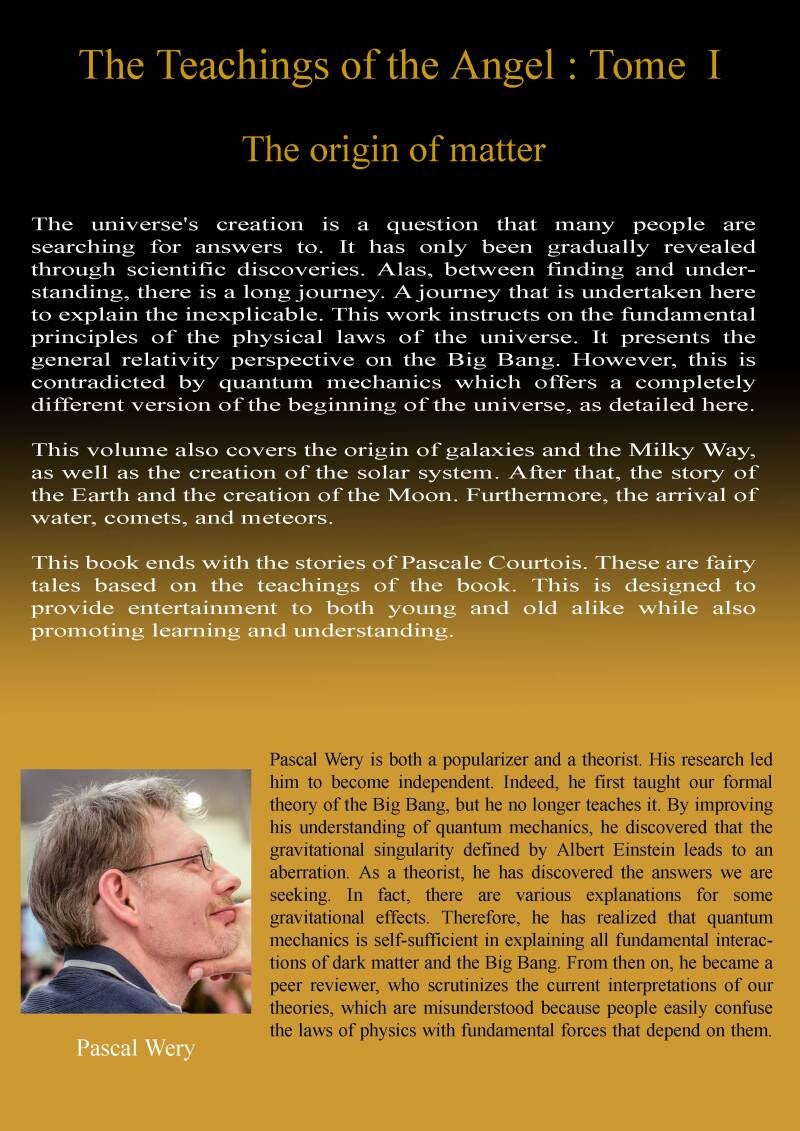
How did the universe form? Many are looking for answers to this question. But these only happen in bits with scientific discoveries. Alas, between discovery and understanding, there is a long work. A work that is done here in order to explain the inexplicable. Thus this work teaches about the fundamental principles of the physical laws of the universe. It gives the point of view of general relativity about the Big Bang. However, this one is contradicted by quantum mechanics. The latter offers a completely different version of the beginnings of the universe, detailed here.