The teachings of the Angel
Occam's razor: inference 1
Supersymmetry fails to explain dark matter while pair production symmetry is more accurate
Subject :
Through the symmetry of pair production, I discovered new theoretical particles whose properties correspond to dark matter. If this is indeed the case, I have also discovered its nature. Thus, it would be possible to create a computer simulation and verify its accuracy. However, the means to do so are beyond my reach. Others, with better equipment, may be able to.
Arguments:
Based on our observations, dark matter remains a great unknown, and we have no model that can account for it, suggesting alternative models. Indeed, if supersymmetry fails because it doesn't produce conclusive results, what about the symmetry of pair production? In this context, energy is not linked to mass (supersymmetry), but rather to its opposite (symmetry of production by opposite pairs).
We then discover energies that discreetly share our universe and produce radiation pressure on a universal scale, causing an expansion of space. These energies also produce matter with properties comparable to dark matter: an enormous quantity of fermions that do not interact with our fundamental forces or with matter and that define vast gravitational fields incapable of collapsing in on themselves. They cannot be created, eliminated, or struck, resulting in no interaction in our particle accelerators, not even a weak one! Similarly, their magnetically charged fermions can explain the formation of super black holes in the early universe, leading to its rapid maturation into galaxies and stars.
Finally, these energies and their matter can be simulated using a computer model that is beyond my capabilities but is accessible to others... many others! Indeed, simulations are not the domain of a select few, but of all professionals in the field! I'm thinking particularly of communities of engineers who would be interested in trying to verify this inference in order to develop it from a simple "theory" to a "scientific theory." This development is necessary to confirm or refute this theory. It's up to each individual to analyze the available arguments and decide whether or not to accept them. I'm not forcing anyone, but... if it is indeed the correct theory and it's within your expertise, don't miss out on the Nobel Prize... verify it! Indeed, the story of Georges Lemaître teaches us that it is not the theorist who receives the Nobel Prize, but the one who proves the correctness of the theory. So, if this aligns with your abilities, you have the right to be ambitious and try to win the Nobel Prize by performing the simulation yourself. Good luck to these adventurers of knowledge.
Introduction :
Dark matter is one of the greatest unknowns of the cosmos, despite being its most significant gravitational component. Indeed, dark matter is the most abundant, and its volume has a profound impact on our understanding of the universe. It has enabled the construction and preservation of cosmic structures. Thus, understanding the cosmos without knowing its properties is extremely difficult. However, it only interacts with gravity.
In the microcosm, no direct interactions with dark matter have been clearly identified. Due to this lack of interaction, supersymmetric particles or WIMPs also seem like dubious concepts. In fact, does the dark matter we are looking for react little or not at all? For example, the Sun combines only a few ions because it is a rare quantum tunneling fusion. Thus, only the exception fuses, not the bulk. Therefore, the Sun has been shining for a very long time and will continue to do so for billions of years. However, only a small amount of mass is converted into energy in this fusion. As a result, the sun radiates "little" with "little"... a gigantic mass! This unlimited number of particles multiplies the probability of combination, making the sun shine. Dark matter is thought to be abundant because it is responsible for the majority of the universe's gravity. Thus, reacting "little" with "little," but with all that mass, must inevitably lead to consequences, however minor, as with neutrinos. Surprisingly, this doesn't appear to be a weak reaction, but rather the complete absence of direct reactivity with whole integer spin (energy) or half-integer spin (matter), even in our particle accelerators. Indeed, dark matter is not only invisible to us because it has no measurable electromagnetic field, but it also exhibits no nuclear reactions. The only observed effects are gravitational. This lack of interaction leads to the conclusion that dark matter seems completely unaffected by our energetic forces or our matter.
In the macro-world, there are also contradictions between predictions (the number of small galaxies and their orbits) and certain observations of dark matter. Its distribution appears to be unexpected. Indeed, the size of its gravitational fields and the absence of a nucleus indicate that dark matter can only affect large areas without being able to concentrate too much (no nucleus), suggesting that it lacks cohesion.
In conclusion, the only thing we know about it is its non-properties, or what it doesn't do: interact with our own matter and fundamental forces (except for gravity). It also only covers enormous areas (large gravitational lenses). Consequently, it remains a great mystery that doesn't fit any prediction, leading to the suggestion of alternative models for dark matter.
The starting point is to apply the correct symmetry. Indeed, if supersymmetry fails because it doesn't generate results, what about the symmetry of opposite pair production? This is the only other symmetry that could exist: in essence, the opposite of everything is generated; therefore, every north pole is produced with its south pole, every charge with its opposite, and every polarity with its reversed spin. Even the EPR paradox is based on pair production, which is a quantum entanglement that immediately generates a pair of antisymmetric spins. Therefore, it seems that the production of opposite pairs is a recurring phenomenon. I refer to this symmetry as a type of universal equilibrium, like the others (translation, rotation, time, and charge).
In this context, energy is not related to mass (supersymmetry), but rather to its opposite (opposite pair production symmetry). Therefore, we look for energy characteristics that are opposite to our own, just as antimatter is opposite to matter. In short, we extrapolate the half-integer spin conflict with the whole integer spin.
Discussion :
What about the symmetry of production by opposite pairs with energy? There would be two types of energy: positive and negative. However, since energy can take the same quantum state in the same spacetime (undifferentiated), these two forms can coexist without touching. In fact, energy does not interact with itself; rather, it concentrates on matter. Thus, intersecting lasers do not make contact with each other (undifferentiated). They simply combine their energies, and their interactions do not oppose each other but add up! Consequently, positive and negative energies can coexist in the same universe; there is no annihilation between these two opposites since they do not touch.
But what do the terms "positive and negative energies" mean? It means that the properties of the energies must be reversed, but they are identical to our own: the electromagnetic and nuclear forces. In short, these antisymmetric forces are essentially our own energy forces reversed. However, our fundamental forces are primarily cohesive forces. Reversing such forces would lead to a repulsive rather than an attractive effect. The idea is that what attracts becomes what repels. For example, the powerful reversed nuclear force is a repulsive force instead of a binding force. Consequently, it doesn't bind its quarks together, but rather separates them.
The force of gravity, on the other hand, is an exception: the Higgs boson, which initiates mass, has a spin of zero, not a whole integer spin. Indeed, a spin of zero has quite different characteristics from an integer spin: the direction of the whole integer spin (vector) is important, whereas the orientation of the spin of zero (scalar) is meaningless. Therefore, as soon as quanta of energy activate a fermion (matter) or antifermion (antimatter) field, they also activate the Higgs field, which gives mass to any half-integer spin, whether matter or antimatter. Consequently, we can conclude that this reversal of forces has no impact on any mass. In short, the inverse of gravity caused by mass is itself.
These opposing energies, like our own, produce matter whose masses will automatically follow gravity. However, these masses are only affected by these opposing forces and not by our own. These are repulsive forces that affect their matter, forcing them to disperse into space. Consequently, the Pauli exclusion principle has no effect on them. This principle prohibits identical matter particles with the same properties from sharing the same spacetime. However, because these particles have different attributes, they can do so. Furthermore, because they do not react to our fundamental forces, they are completely invisible and undetectable to us. Consequently, even if they covered our entire horizon, we would not be able to distinguish them! Except by their gravity, since they are still material forms, and therefore have half-integer spins. Due to these characteristics, they interact with the Higgs field, which gives them mass that can increase in response to energies such as heat.
These substances, being associated with repulsive forces, would violently repel each other. As a result, there would be no baryogenocide (annihilation of matter) with baryogenesis (production of matter). Indeed, with our fundamental forces, matter comes into contact with antimatter, and only a small percentage survives. This residue of matter constitutes our observable cosmos. However, because these strange substances would repel each other, there would be no conflict since everyone would flee from one another. Consequently, because they would not interact with each other, these substances and their antimatter forms would coexist peacefully. This means that the number of their particles would be far greater than ours. Furthermore, due to repulsive forces, they would never collapse in on themselves. Therefore, their mass could not form a concentrated gravity (gravitational core or spike). On the contrary, these substances would be fluid and imperceptible, while, due to their vast quantity, they would spread over immense areas.
They would prefer to follow a non-repulsive mass, that is, a mass that doesn't react with their own forces. In short, they would prefer to follow our matter rather than their own, and thus follow all these gravitational fields. Fields that they would amplify with their own mass. And because of the large quantity of this matter with its antimatter, these areas would be very wide. Doesn't that remind you of something? Why, phantom gravity! In other words, we're talking about dark matter! Dark matter: a simple pair production symmetry that begins with energy! Interesting, isn't it?
Similarly, these particles would also react with the effect of the quantum vacuum, which exerts pressure. With our matter, the vacuum pressure is minimal, but with repulsive particles, it would become considerably stronger. Since the inverted strong force and electromagnetism are repulsive, they would exert maximum pressure on their virtual particles in the quantum vacuum. All of this would produce a universal repulsive field. Is there anything else this reminds you of? Perhaps the expansion of the universe? If so, the expansion of space depends on the opposing force of gravity. Therefore, pressure varies with the density of the universe. The expansion of a dense universe, full of gravity, is slow, while an empty universe, with little gravity, expands more rapidly. This means that the expansion of the universe is accelerating over time, especially where gravity is weak, as observed.
Going further, we can also consider electromagnetism, which is repulsive between same charges. In this case, a reversal of the fundamental forces creates an attractive effect between same charges. Thus, opposite leptons might attract each other if they have the same charge and repel each other if they have different charges. Consequently, these electrons repel their positrons but bond with each other, and vice versa for the positrons. Given the incredible mass of this matter, such an arrangement would lead to the collapse of its leptons into extremely massive black holes. The smallest would be intermediate in size, but many would be supermassive black holes. Consequently, they would follow and amplify the initial gravitational fluctuations of the universe, leading to the formation of quasars. Thus, they would be at the origin of a very mature universe, as giant galaxies would have formed very early on! This is demonstrated by the observations of James Webb.
Findings :
Thus, by extrapolating the pair production symmetry, we can discover a very strange energy and matter with characteristics that seem to correspond to the dark force and dark matter. Indeed, these energies not only produce radiation pressure on a universal scale but also compounds with properties comparable to dark matter: an enormous quantity of fermions that do not interact with our fundamental forces or matter and that define vast gravitational fields incapable of collapsing in on themselves. They cannot be created, destroyed, or struck, resulting in no interaction in our particle accelerators, not even a weak one! In conclusion, one symmetry is not the same as the other: pair production symmetry wins while Suzy loses. Yet, everyone focuses on the losing supersymmetry instead of considering the winning symmetry!
Conclusion :
In this cosmos, everything is produced in opposite pairs. This is not a coincidence; it is the result of physical principles. These principles are not local but universal; they are applicable throughout the entire cosmos. Thus, every North Pole has a South Pole, every spin has an inverted rotation, every particle has an antiparticle, and every energy has an opposite. The formation of pairs is a random, equidistant, immediate, and global phenomenon. The only thing that seems unique is spacetime itself, which is shared by all particles. This spacetime reacts to gravity due to the mass of all its matter, regardless of type. Indeed, the fact that the Higgs boson is a scalar prevents it from being inverted.
Demonstration :
This theory provides sufficient grounds for further research through simulations that are beyond my expertise. We must consider a spherical space in an initial state of the universe with uniformly distributed (but stationary) dark particles obeying gravity and the strong interaction of dark matter. That is, considering only its repulsive effects: interactions with quarks are attractive (+1, +2, +3), but must be reversed into repulsive interactions (-1, -2, -3). The process should be allowed to develop before adding a concentrated neutral mass (a 5% mass ratio), and then all the movements should be examined. In my opinion, all the dark particles will follow the neutral mass, forming a large cloud and adding their own mass in the process (thus reinforcing the formation), but without being able to concentrate too much (no gravitational core). After verification, a larger simulation involves modeling the Milky Way (galaxy) by adding the gravitational fields obtained on a smaller scale and verifying the cohesion of the system. This should allow us to explain each gravitational point in our galaxy and thus answer Vera Rubin's question: where did its missing mass go?
If this is the case, this simulation would deserve a Nobel Prize, as its author would also have demonstrated the existence of dark matter! Indeed, the story of Georges Lemaître teaches us that it is not the theorist who receives the Nobel Prize, but the one who proves the validity of the theory. Best wishes to these explorers of knowledge.
Conflict of interest :
This theory is related to a book : “The origin of matter”. This book is a product of a French encyclopedia named “Les Enseignements de l’Ange”. This collection has a lot of theories, including the beginning of life in the second tome (Les origines de la vie). So, there is conflict of interest: being right makes sales while being wrong makes idiots! This can lead to human blunders. This is why we must exercise caution: because conflict is unavoidable, information can only be validated if it is confirmed by a computer simulation.
The debate :
Science is strange: we make extraordinary discoveries but since we do not understand them, we often miss out on little wonders. Here is an example: the pair production symmetry is misunderstood and underestimated.
References :
Zavala J, Lovell MR, Vogelsberger M, Burger JD. Diverse black matter density at sub-kiloparsec scales in Milky Way satellites: Implications for the nature of black matter. Phys. Rev. D 100, 063007 (2019)
Benito M, Criado JC, Hütsi G, Raidal M, Veermäe H. Implications of Milky Way substructures for the nature of black matter. Physical Review D 101, 103023 (2020)
Beltran M, Hooper D, Kolb EW, Krusberg ZA, Tait TM. Maverick black matter at colliders. Journal of High Energy Physics 1009:037, 2010
Metcalf RB, Silk J. A Fundamental test of the nature of black matter. The Astrophysical Journal May 1999 Volume 519, Number 1
Post:
The nature of black matter : an extrapolation of pair creation :
International Journal Of Creative Research Thoughts (IJCRT.ORG) :
https://doi.org/10.56975/ijcrt.v11i12.247761
These informations come from this book : the evolution, part 1 : the origin of matter.
This volume explores the Dark Force, dark matter, and black holes, revealing the surprising complexity of the origin of matter. It explains the formation of galaxies from clouds, but also from supermassive black holes (quasars) thanks to dark matter. It also recounts the origin of the Milky Way, then the creation of the solar system. Next comes the story of the Earth and the Moon, with the arrival of water, comets, and meteors. This essay concludes with stories by Pascale Courtois, inspired by the book's teachings. Thus, young and old alike are entertained while enriching their knowledge and understanding.

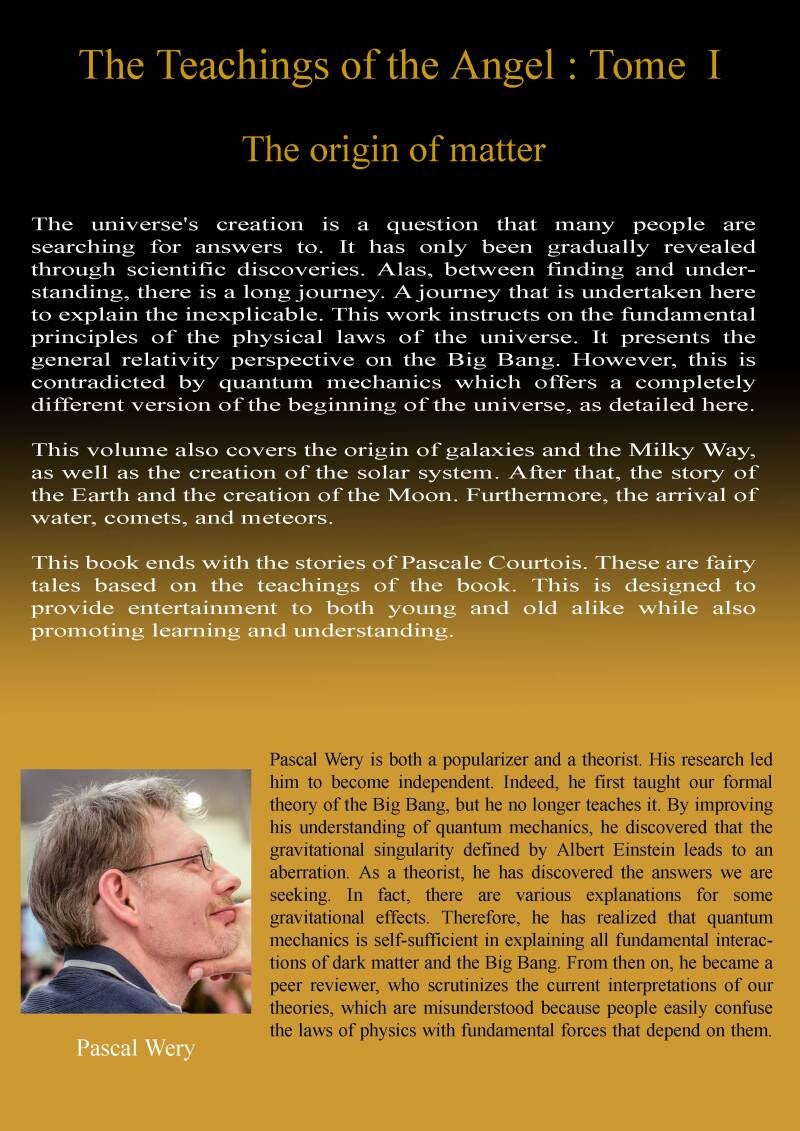
How did the universe form? Many are looking for answers to this question. But these only happen in bits with scientific discoveries. Alas, between discovery and understanding, there is a long work. A work that is done here in order to explain the inexplicable. Thus this work teaches about the fundamental principles of the physical laws of the universe. It gives the point of view of general relativity about the Big Bang. However, this one is contradicted by quantum mechanics. The latter offers a completely different version of the beginnings of the universe, detailed here.